top of page

You'll never know what you'll find until you try

The weather showed snow for the two nights prior to the last Bearcamp Trackers outing. Snow is a great substrate. It comes in so many forms and depths and firmnesses, it can be easy, challenging, or nearly impossible. Usually, the day after a storm will yield some tracks- mostly rodent and squirrels, but it seems like many of the animals hunker down the day after a storm. I've heard that they want to let the snow firm up a bit so it's easier to travel on. I went into the outing with low expectations for finding tracks but having a lot of gratitude for getting outside, seeing folks, and hiking around in the woods.


But, this the lesson here, the human mind shapes expectations and extrapolates your outcome before you go out. If I hadn't been facilitating the group, I probably wouldn't have gone out tracking because I was so sure I wasn't going to see anything that interesting... and I would've made myself right. I wouldn't have seen any tracks... from the couch. You fail every time you don't try...


On the beautiful blue sky day following the night's snowfall, we had a great turnout! We shared gratitudes and names and started down the Old Mast Road from the Ferncroft Trailhead.


We talked about a leg scissor movement like a walk or trot and how that creates nice consistent strides lengths. As you look down the trail, walking tracks will zig-zag between left and right tracks, while trots may appear like a straight line of tracks.


Super fresh walking tracks of 3 Moose I saw on the ride home. Note the clear left-right zig-zag pattern. The stride of these tracks are consistent.
Walking tracks of a Porcupine I saw on the ride home. Note the clear left-right zig-zag pattern. The stride of these tracks are consistent. The feet of the Porcupine turn inward and the hind tracks are distinctly larger than and tend to land in front of the front tracks. They also lack toe impressions. They look like two different sized potatoes but when you look closely, you will often find claw marks.
This photo was taken on a different day. Notice how the tracks of this trotting House Cat have only a minute right-left quality as you look down the trail. The stride of these tracks are consistent.

The body scissor movement is where the entire body is moving together and than apart, rather than just the legs. These movements indicate a greater energetic intensity for animals like Dogs, Cats, Deer but they are just the baseline, high efficient movement for Squirrels, Rodents, and Weasels. Body scissor gaits include Bounds, Lopes, and Gallops, and they land in groups 2, 3, or 4 and are not consistent in stride length.

This photo of a bounding House Cat was taken on a different day. It shows a group 3 tracks, a space and than another group of 3 tracks.

We saw very old 2x2 loping fisher tracks. I didn't get a photo but we could tell what the height of the animal was because it investigated a fallen log and went underneath the log, rather than going over or around the log. We compared small Mouse tracks/tunnels to Red Squirrel tracks/tunnels along a different fallen tree. We also found an older fox track in a trot. It was the best track we had found for the day, so we followed it a little ways and they led us to our best trail of the day.


Bobcat walking over a downed tree.

Bobcat splaying their foot out like a snowshoe to help them walk over the thin crust. Note the carpal pad (heel of the front foot) registering to the back of the first track on the outside (left side) of the left foot.
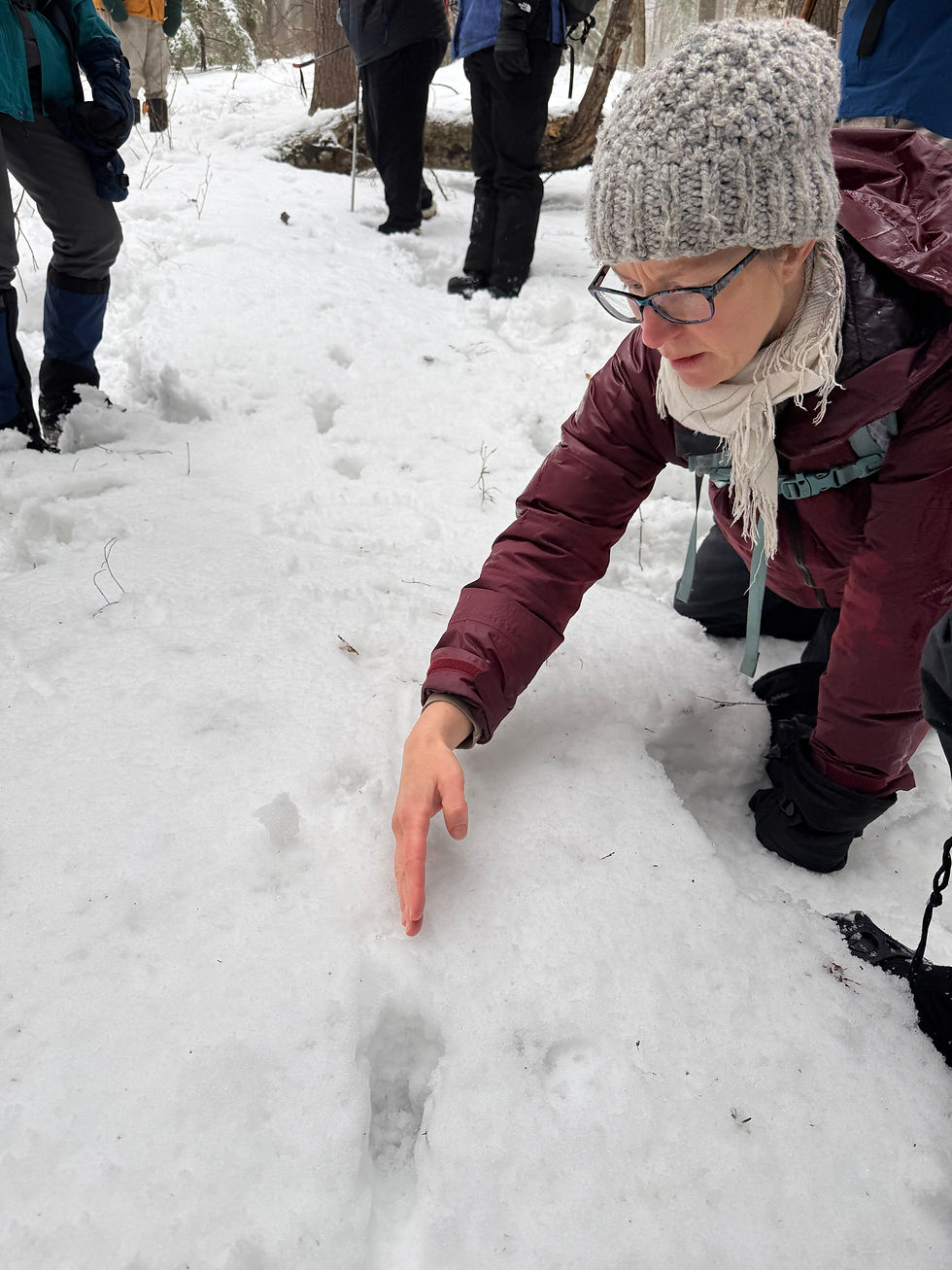
Hillary leading the discussion of the Bobcat trail
Splayed Bobcat tracks with a large Meta (palm) pad

Many thanks to everyone that showed up and to the animals that give us so many stories and so much joy!


Comments


CONTACT
US

Scheduled and Custom Events 

In New England

Email: newenglandwildlifetracking@gmail.com

At the foot of the White Mountains 

in Tamworth, New Hampshire


ASK
US

bottom of page